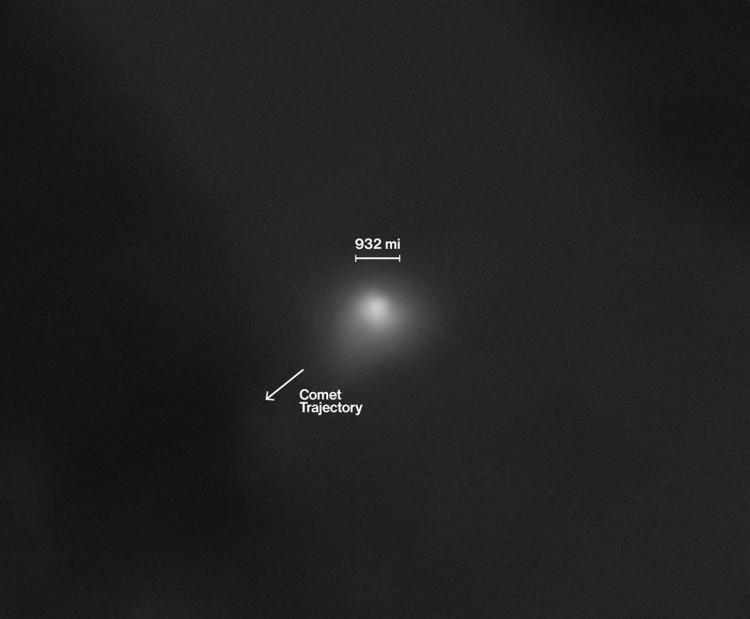
(Photo: NASA/JPL-Caltech/University of Arizona)
Astronomers studying the interstellar comet known as 3I/ATLAS have detected a vast and unexpected X-ray halo extending roughly 250,000 miles around the object, a finding that is challenging long-standing assumptions about comet behavior and the interaction between solar wind and material formed beyond the Solar System. The observation was made by the X-Ray Imaging and Spectroscopy Mission, or XRISM, a joint project led by Japan's space agency JAXA with participation from NASA and the European Space Agency.
The comet, formally designated C/2025 N1 (ATLAS), is only the third confirmed object known to have entered the Solar System from interstellar space, following 1I/ʻOumuamua in 2017 and 2I/Borisov in 2019. Its trajectory is hyperbolic, meaning it is not gravitationally bound to the Sun and will leave the Solar System permanently.
XRISM recorded the X-ray emissions during observations conducted between Nov. 26 and Nov. 28, detecting a diffuse glow surrounding the comet's coma that extends farther than the Earth-Moon distance. While X-ray emission from comets was first identified in 1996 during observations of Comet Hyakutake, such emissions have until now been associated exclusively with objects formed within the Solar System.
In conventional comet models, X-rays are generated through charge-exchange reactions, when highly charged ions from the solar wind collide with neutral atoms released by a comet. The scale and faintness of the halo around 3I/ATLAS suggest an unusually extended and sparse cloud of gas, raising questions about whether standard charge-exchange processes alone can explain the phenomenon.
Complicating the analysis is the comet's origin. Based on its velocity and trajectory through the Milky Way, researchers believe 3I/ATLAS likely formed in the galaxy's thick disk, a region dominated by stars that formed between roughly 7 billion and 11 billion years ago. That would make the comet significantly older than the Sun, which formed about 4.6 billion years ago.
Separate observations by the Atacama Large Millimeter/submillimeter Array in Chile have already indicated that 3I/ATLAS carries a chemical signature unlike that of Solar System comets. Measurements show elevated levels of methanol and hydrogen cyanide, compounds associated with prebiotic chemistry but present here in ratios rarely seen in objects from the Kuiper Belt or Oort Cloud.
The comet's behavior since its discovery in July 2025 has repeatedly defied expectations. Astronomers have documented multiple narrow jets of material, an unusually red surface coloration, and extreme negative polarization, all of which differ from known cometary norms.
The timing of the XRISM detection adds urgency to the scientific effort. 3I/ATLAS became visible again in late October after passing behind the Sun and will reach its closest approach to Earth on Dec. 19, at a distance of roughly 167 million miles. By early 2026, it will be too distant for detailed observation.