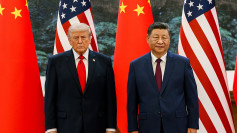
China's economy expanded 5.0% in 2025, meeting Beijing's official growth target by leaning heavily on exports and capturing a record share of global goods demand, even as weak household spending and a deep property downturn continued to chill the domestic economy. The strategy helped cushion the impact of U.S. tariffs under President Donald Trump, but economists warn it is becoming increasingly difficult to sustain.
Official data released Monday showed the world's second-largest economy growing 4.5% year-on-year in the fourth quarter, slightly ahead of expectations but slowing to a three-year low from the third quarter's 4.8% pace. Industrial output rose 5.9% in 2025, outstripping 3.7% growth in retail sales, while property investment plunged 17.2%, underscoring the widening gap between export-led manufacturing and consumer-facing sectors.
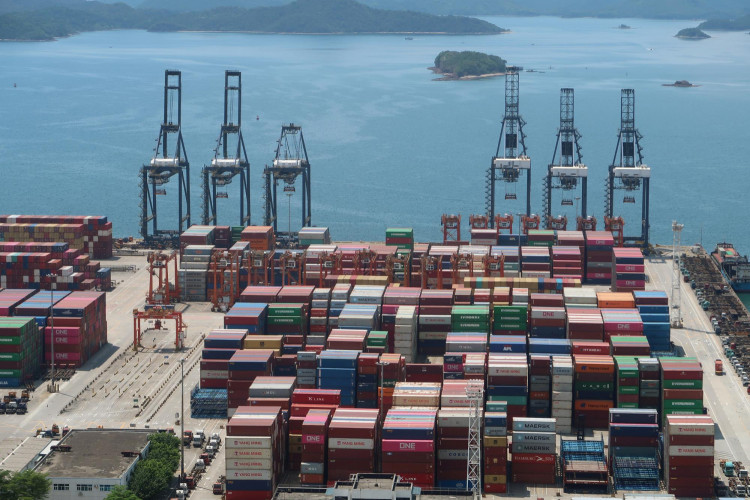
China's export push drove the country's trade surplus to a record $1.2 trillion, up 20% from 2024 and roughly equivalent to the size of a top-20 global economy such as Saudi Arabia. Shipments to the United States fell by about 20%, but exports surged to Europe, Latin America and other regions as Chinese manufacturers sought to offset tariff pressure.
"We're doing well in Europe and Latin America and we don't need that market," said Dave Fong, who co-owns three factories in southern China producing goods ranging from school bags to industrial machinery. "About 15% of his orders used to come from the U.S., but that's now down to a trickle."
The export boom stands in sharp contrast to conditions at home. Fixed-asset investment shrank 3.8% in 2025, the first annual decline since records began in 1996, reflecting mounting pressure on local governments to rein in debt. Private investment fell 6.4%, signaling that businesses see little incentive to expand amid overcapacity and subdued consumer demand.
"If real estate is doing poorly, the impact on our whole industry is very large. Same for infrastructure," said Scott Yang, who runs a pipe-fitting valve factory in eastern China. "It's hard to quantify, but qualitatively this winter feels piercingly cold."
Officials acknowledge the imbalance. Kang Yi, head of the National Bureau of Statistics, described China's economic performance last year as "hard-won," citing "strong supply and weak demand" as persistent challenges.
Economists warn that relying on exports to power growth could provoke increasing resistance abroad. "It's hard to imagine how the trade surplus could continue to expand at this clip indefinitely into the future, if only because that would incur a wider protectionist backlash abroad," said Christopher Beddor, an economist at Gavekal Dragonomics.
Beijing has begun modest efforts to stimulate demand. The central bank last week announced a 1 trillion yuan ($144 billion) targeted credit program for private enterprises, while existing policies include incremental increases in pensions, childcare subsidies and an extension of a consumer goods subsidy scheme into 2026. Analysts argue these steps fall short.