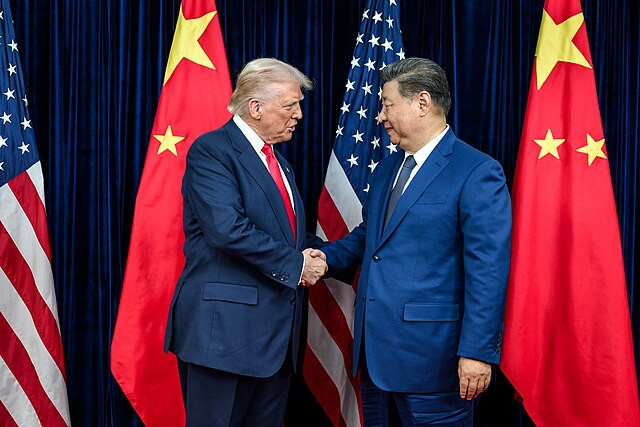
Donald Trump and Xi Jinping opened their closely watched summit in Beijing with familiar diplomatic pageantry on Thursday, but it was a brief handshake between the two leaders that quickly dominated online conversation and overshadowed the opening moments of talks centered on trade, Taiwan and Iran.
Footage from the meeting at the Great Hall of the People showed Trump gripping Xi's hand tightly and appearing to pull slightly toward himself, reviving years of scrutiny over the American president's unusually forceful greeting style.
Critics on social media immediately framed the exchange as another example of Trump's so-called "power handshake," a gesture that has become one of the defining visual trademarks of his diplomatic appearances since his first presidency.
"Trump attempts his juvenile power move, tug-of-war handshake, with President Xi, who knows exactly how to handle a malignant narcissist," one user wrote on X after the clip spread online. Another observer argued Xi "comes across as the one quietly dominating the interaction by refusing to play long or show any tension."
The exchange itself lasted only moments, but analysts and social media commentators dissected it frame by frame, focusing on Xi's rigid posture, steady expression and refusal to lean forward despite Trump's visible tugging motion.
The scene echoed previous viral encounters involving Trump and other world leaders, including Emmanuel Macron, late Japanese Prime Minister Shinzo Abe and, more recently, King Charles III during the British monarch's recent US state visit.
During that earlier meeting, commentators noted that Charles refused to release his grip first and maintained a firm stance throughout the unusually long handshake, which reportedly lasted about 10 seconds.
In Beijing, Xi appeared to adopt a similarly controlled approach. Social media users highlighted how the Chinese president kept his elbow tucked close to his body - a technique often recommended by body-language specialists to prevent being physically pulled off balance during a handshake.
One widely circulated comment on X read: "Xi tucked that elbow in and didn't give. He just said, 'You're in my country bud, I'm the captain now.'"
The online fascination with the greeting contrasted sharply with the formal rhetoric both leaders used once bilateral talks began. Trump opened the meeting by emphasizing what he described as a productive personal relationship with Xi despite years of escalating trade tensions between Washington and Beijing.
"We've gotten along, when there were difficulties we worked it out. I would call you and you would call me," Trump said. "Whenever we had a problem we worked it out very quickly."
He then turned openly complimentary toward Xi, adding: "I say it to everybody, you're a great leader."
Trump also attempted to frame the visit as a major commercial and geopolitical success, telling Xi he had traveled with "the best [business leaders] in the world" and "only the top people here today to pay respects to you."
The summit delegation included prominent American executives such as Tim Cook, Elon Musk and Jensen Huang, underscoring the continuing economic interdependence between the two countries despite the recent tariff war.
Xi, by contrast, adopted a broader and more strategic tone in his prepared remarks. He described the US-China relationship as central to global stability and warned that the world was experiencing "transformation not seen in a century."
"The whole world is watching our meeting," Xi said before asking whether China and the United States could "overcome the Thucydides trap and create a new paradigm of relations."
He continued with a series of sweeping questions directed at the future of the bilateral relationship: "Could they meet global challenges together and provide more stability for the world?"
"These are the questions vital to history, to the world, and to the people," Xi said. "They are the questions of our times that you and I need to answer as leaders of major countries."