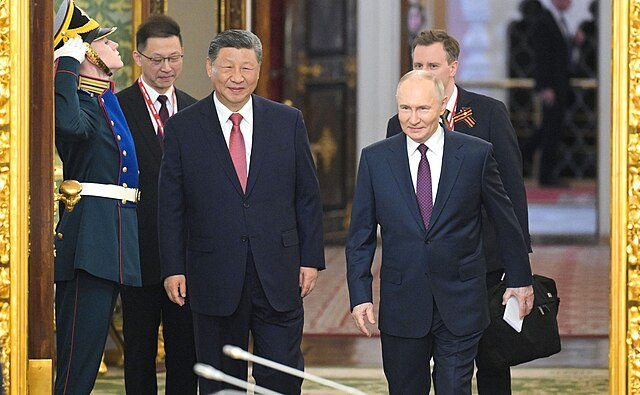
Vladimir Putin arrived in Beijing on Tuesday for high-stakes talks with Xi Jinping, just days after Donald Trump concluded a separate summit in China that produced warm rhetoric but few publicly verifiable commitments.
The timing of the visit has sharpened attention on Beijing's evolving geopolitical strategy as China positions itself at the center of increasingly fragile global power relationships involving Washington, Moscow and the broader Western alliance.
Chinese state media described Putin's trip as his 25th visit to China, underscoring the unusually close relationship that has developed between Beijing and Moscow since Russia's invasion of Ukraine reshaped global trade, energy flows and diplomatic alignments.
Putin was greeted at the airport by Chinese Foreign Minister Wang Yi alongside a ceremonial honor guard, with both governments signaling that the summit would focus heavily on long-term strategic coordination rather than symbolic diplomacy alone.
The Kremlin said the two countries were preparing to sign roughly 40 bilateral agreements spanning trade, finance, energy and geopolitical cooperation.
Russian officials also previewed a sweeping joint declaration supporting what Moscow described as a "multipolar world order," language increasingly used by both governments to argue against what they portray as excessive American dominance over international institutions, finance and security arrangements.
Before departing for Beijing, Putin described relations with China as reaching "an unprecedented level," reflecting how central the partnership has become to Russia's economic survival under Western sanctions.
Among the most closely watched topics is the proposed Power of Siberia 2 pipeline project, which would transport Russian natural gas to China through Mongolia and significantly deepen long-term energy ties between the two countries.
For Moscow, the pipeline represents a critical attempt to redirect energy exports after losing substantial access to European markets following the Ukraine war. For Beijing, expanded overland energy infrastructure offers greater supply stability amid ongoing concerns about maritime vulnerabilities and global shipping disruptions.
China has already emerged as one of Russia's most important economic lifelines since the conflict escalated.
According to the Centre for Research on Energy and Clean Air, China has purchased more than $367 billion worth of Russian fossil fuels since the war intensified, helping cushion the economic impact of Western sanctions on Moscow.
The talks are also expected to expand efforts to settle trade using yuan and roubles instead of dollars and euros, part of a broader push by both countries to reduce dependence on Western-controlled financial systems.
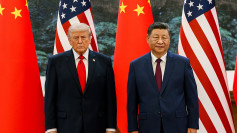
The deepening China-Russia coordination unfolded almost immediately after Trump's own summit with Xi concluded in Beijing.
Trump publicly characterized the meetings as successful and announced that China had agreed to purchase 200 Boeing aircraft. But subsequent statements from China's commerce ministry suggested many of the discussions remained preliminary.
Chinese officials later described negotiations surrounding tariffs, agricultural access and aviation deals as still under discussion, adding that details would be finalized "as soon as possible."
According to Reuters, Beijing did not provide specific figures, timelines or binding implementation frameworks tied to many of the proposed agreements.
The limited public detail surrounding the Trump-Xi summit stood in contrast to the far more expansive agenda previewed ahead of Putin's visit.
Chinese and Russian officials indicated their discussions would extend beyond commerce into broader coordination over infrastructure, finance, technology and global governance.