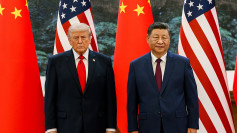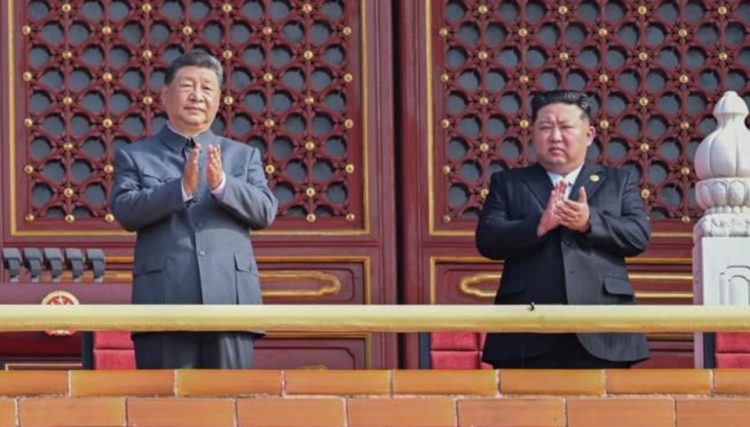
Chinese President Xi Jinping and North Korean leader Kim Jong Un used a high-profile summit in Pyongyang on Monday to showcase deepening ties between Beijing and Pyongyang, signaling closer cooperation on trade, technology, infrastructure and regional security at a time of shifting geopolitical alliances across Asia and Europe.
The visit, Xi's first trip to North Korea in seven years, unfolded with elaborate ceremony in the North Korean capital, where Kim personally welcomed the Chinese leader. State media footage showed military honor guards, a 21-gun salute, schoolchildren waving flags and large crowds lining major boulevards as Xi and his wife, Peng Liyuan, traveled through the city alongside Kim and North Korea's first lady, Ri Sol Ju.
The summit comes as North Korea expands its diplomatic and military engagement with Russia during the Ukraine conflict, while China seeks to maintain its influence over one of its most strategically important neighbors. The meeting also coincided with the 65th anniversary of the China-North Korea mutual defense treaty signed in 1961, a cornerstone of relations between the two countries.
Both governments used the anniversary to emphasize continuity and stability in a relationship that has often been described as one of the closest strategic partnerships in Asia.
According to reports from the South China Morning Post, Xi said Beijing is prepared to strengthen cooperation across a range of sectors, including trade, agriculture, construction and technology. Chinese state messaging portrayed the relationship as an essential pillar of regional stability, while North Korean media highlighted what it described as the enduring friendship between the two nations.
Kim welcomed the Chinese delegation by describing the visit as evidence of the strong ties linking the two governments. Chinese and North Korean outlets repeatedly referred to a "special sense of closeness" between the countries, language that analysts view as a signal of growing coordination amid rising global tensions.
The timing of the summit is significant. Over the past two years, North Korea has expanded engagement with Russia through economic exchanges and military cooperation linked to Moscow's war in Ukraine. That development has generated questions about whether Beijing's influence over Pyongyang could diminish as Kim broadens his international partnerships.
Instead, Monday's summit suggested China remains determined to retain its central role in North Korea's diplomatic and economic future.
Recent improvements in North Korea's economy have also increased the importance of cross-border ties. Trade activity between China and North Korea has gradually recovered following years of pandemic restrictions and sanctions-related disruptions. Chinese companies continue to play a critical role in supplying goods and facilitating commercial exchanges that support segments of North Korea's economy.
The leaders also met against the backdrop of ongoing concerns surrounding North Korea's nuclear weapons program. While no major announcements were made regarding denuclearization or arms control, the issue remained central to the broader context surrounding the talks.
According to NBC News, recent activity at North Korean weapons-related facilities has continued to draw international attention. Neither side indicated any shift in long-standing positions on nuclear capabilities, suggesting that economic and strategic cooperation took priority during the visit.
Beyond bilateral relations, the summit reflects broader geopolitical realignments taking shape across Eurasia. China, Russia and North Korea have increasingly found their diplomatic interests intersecting as tensions with Western governments have intensified.
French broadcaster France24 reported that Chinese officials emphasized continued coordination on regional and international issues, while Kim highlighted the importance of maintaining strong relations with Beijing. The messaging underscored China's desire to remain a key player in shaping developments on the Korean Peninsula while balancing its broader relationship with Moscow.