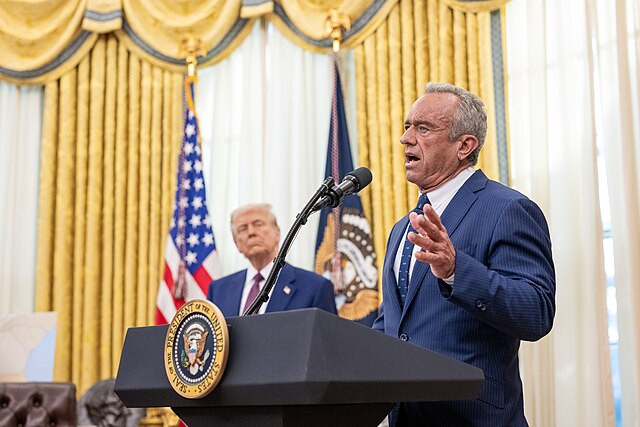
The Trump administration has terminated at least 44 federally funded health-care research grants valued at approximately $63 million, a move that researchers say abruptly halted ongoing projects and redirected Agency for Healthcare Research and Quality (AHRQ) resources toward priorities championed by Health and Human Services Secretary Robert F. Kennedy Jr.
The grant cancellations, communicated through nearly identical termination letters from AHRQ, affected research institutions across the United States. Scientists said they had spent months waiting for annual funding installments that never arrived following last year's 43-day federal government shutdown, only to learn that their awards had been canceled without project-specific explanations.
The letters stated that AHRQ was redirecting funding "to better prioritise agency resources" toward programs that "best serve the interests of the federal government." Beyond that language, researchers said they received little information about why individual projects were discontinued.
Aaron Carroll, president of AcademyHealth, a nonpartisan organization that promotes evidence-based health policy, said his group identified at least 44 canceled grants totaling $63 million over the coming years.
"People were caught totally off guard and are absolutely in a panic," Carroll told Notus.
According to Carroll, projects covering a wide range of medical and health-policy topics received nearly identical termination notices despite addressing different research questions. An HHS spokesperson did not respond to requests for comment, leaving unanswered questions about who authorized the cancellations and what evaluation process, if any, guided the decisions.
The funding changes coincide with a broader policy shift inside the Department of Health and Human Services. The AHRQ letters identified several new priority areas for future research, including nutrition, autism, telehealth, long COVID, artificial intelligence, antibiotic resistance and what the agency described as the "overmedication of children."
Several of those themes closely align with Kennedy's "Make America Healthy Again" agenda, which has emphasized nutrition, chronic disease and skepticism toward aspects of conventional medical practice. The overlap has prompted questions from researchers about whether political priorities are reshaping federal health research funding.
Some scientists also pointed to apparent inconsistencies. Although antibiotic resistance was listed among the agency's priorities, at least one terminated project focused specifically on combating antibiotic-resistant infections.
Unlike the National Institutes of Health, which primarily funds biomedical discoveries and disease research, AHRQ concentrates on improving how health care is delivered. Its grants often examine hospital operations, patient safety, health insurance systems and methods for improving outcomes across the medical system.
Typical AHRQ awards range from roughly $300,000 to $3 million over periods of two to five years. While relatively modest compared with larger federal biomedical grants, they frequently provide essential funding for research teams, early-career investigators and long-term health policy studies.
Researchers say the cancellations have already forced difficult personnel decisions.
Eric Roberts, a professor at the University of Pennsylvania, told Notus that his research focused on improving care for older, lower-income Americans enrolled in both Medicare and Medicaid. When expected grant payments failed to arrive after the federal shutdown, he initially believed administrative delays were responsible.
"We didn't hear anything after the federal shutdown," Roberts said.
As uncertainty continued, Roberts said he laid off a postdoctoral researcher and reassigned other employees to projects supported by alternative funding sources.
"We've managed to eke out two papers in the last year but they are truncated," he said.
The uncertainty extends beyond established investigators. Several canceled grants had been structured as career-development awards designed to give younger researchers protected time away from clinical work or teaching responsibilities while building independent research programs.
Dr. Nora Becker, an assistant professor at the University of Michigan Medical School, said her AHRQ award had allowed her to devote most of her professional time to research during the past three years.
"I don't know anybody who has ever lost a career development award the way I have," Becker said. "It has introduced a huge amount of stress and uncertainty."
Her university has temporarily reduced her clinical workload while she seeks replacement funding, but Becker said the sudden loss of support threatens the continuity necessary to establish a long-term academic research career.