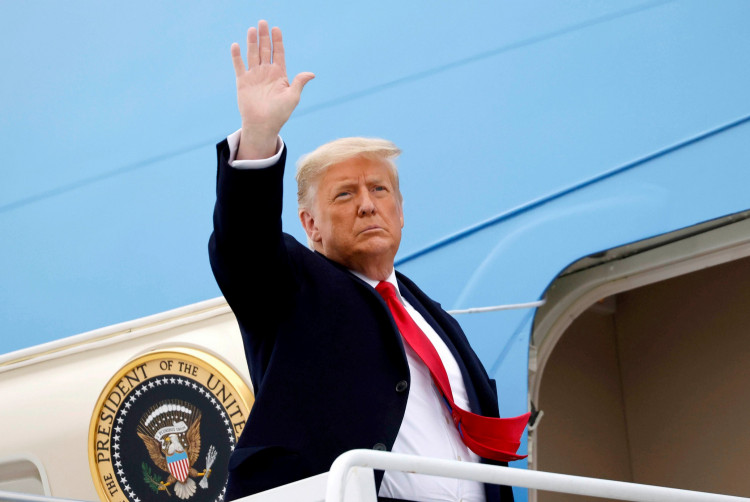
President Donald Trump departed the NATO summit in Ankara aboard an older Air Force One aircraft instead of a recently acquired Boeing 747-8 that has become the subject of political and security debate, saying the decision reflected concerns over threats from Iran as tensions between Washington and Tehran escalated.
The change in aircraft came less than a day after the United States launched strikes against Iranian targets in response to attacks on commercial shipping, reigniting military tensions between the two countries. It also renewed scrutiny of the Boeing 747-8 accepted by the Pentagon from Qatar's royal family, an aircraft that has faced criticism over its conversion costs, security capabilities and legal status.
Speaking to reporters before leaving Turkey, Trump repeatedly referenced what he described as a direct threat from Iran when asked why he would not fly home aboard the newer aircraft.
"I'm No. 1 on the kill list for Iran," the president said.
"I don't really care because I'm doing my job."
Trump then joked that he would rather be "No. 1 on TikTok," before adding, "But I'm No. 1 on the list for killing."
Rather than accompany the president back to Washington, the newer Boeing 747-8 flew to the United Kingdom, where Trump said it would stop at RAF Mildenhall so U.S. military personnel could view the aircraft. Both presidential planes ultimately made the unscheduled stop at the British air base.
The aircraft itself has remained at the center of an ongoing political dispute. The Boeing 747-8 was transferred as an unconditional gift from Qatar's royal family and has been valued at approximately $400 million. After the Pentagon accepted the aircraft last year, defense contractor L3Harris completed an accelerated conversion intended to allow the jet to serve as an interim presidential aircraft until Boeing delivers two next-generation Air Force One replacements.
The program's financial details remain contested.
Key figures cited in the debate include:
- Boeing's original Air Force One replacement contract: $3.9 billion
- Estimated value of the Qatar Boeing 747-8: about $400 million
- Air Force estimate for security modifications: under $400 million
- Estimate cited by Democratic lawmakers and independent analysts: approximately $934 million
The delivery delays affecting Boeing's replacement aircraft have further complicated the issue. The company originally expected to deliver two purpose-built Air Force One aircraft in 2024 under its fixed-price contract signed in 2018. That timetable has slipped until at least 2028, forcing the administration to rely on the converted Boeing 747-8 as what Trump has previously described as a "bridge" aircraft.
The aircraft has also generated constitutional questions. Democratic lawmakers argue that accepting such a valuable aircraft from a foreign government could violate the Constitution's emoluments clause. According to the administration, legal approval was granted because ownership of the aircraft is expected to transfer to Trump's presidential library foundation by early 2029.
Security considerations have become another focal point.
Defense analysts have noted that publicly available images suggest the converted aircraft lacks some of the sophisticated defensive systems installed aboard the long-serving presidential fleet. The older Air Force One aircraft were built with Cold War-era survivability features, including hardened structures, missile-warning and countermeasure systems, aerial refueling capability and extensive secure communications.
The U.S. Air Force has defended the conversion process, stating that it was completed "without accepting any risk regarding security, safety, or secure communications," while acknowledging that some engineering work planned for the permanent replacement aircraft has not yet been incorporated into the interim jet.
White House Communications Director Steven Cheung likewise dismissed suggestions that the aircraft presents additional risk.
"The new Air Force One is a state-of-the-art aircraft that has been fitted with high-level security protocols that ensure the safety of the President and his staff," Cheung said.
Regional geography added another layer to the president's travel decisions. Turkey shares a border with Iran, whose military possesses ballistic missiles and armed drones capable of reaching Turkish territory. According to the Center for Strategic and International Studies, Iran does not possess weapons capable of striking England, where the aircraft later landed.
Additional security measures also accompanied Trump's return flight. According to the report, the older Air Force One disabled its publicly visible transponder shortly after departure, a practice more commonly associated with operations in higher-risk environments. Flights carrying leaders from other NATO countries, including Germany and the United Kingdom, remained publicly trackable during the same period.