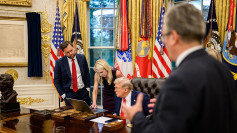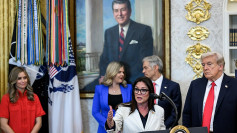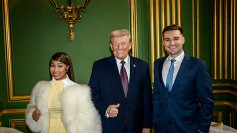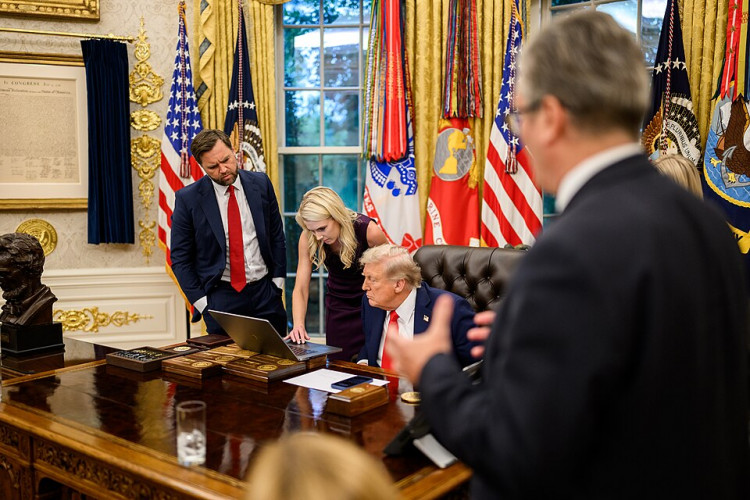
President Donald Trump gave Natalie Harp and two other White House aides $45,000 each in holiday cash gifts, payments that a former White House ethics lawyer says may run afoul of a federal prohibition on supplementing government salaries. The White House says the gifts were personal, unrelated to government work and permissible under federal law.
Annual financial disclosures released by the administration show that Harp, communications adviser Margo Martin and deputy director of Oval Office operations Chamberlain Harris each reported a $45,000 "Cash Gift for Holidays" from Trump. Walt Nauta, director of Oval Office operations, separately disclosed receiving $20,000, bringing Trump's reported gifts to the four aides to $155,000.
The size of the payments is unusual in relation to the aides' government compensation. Harp, Martin and Harris each earn $150,000 annually, meaning each $45,000 gift was equal to 30% of her annual White House salary. Nauta earns $175,000 a year.
The disclosures don't establish that the payments were compensation for government service, a distinction that is central to determining whether they violated federal law. The administration described them as holiday gifts, and the White House said Trump has a history of giving Christmas presents to employees and others around him in both government and private business.
Richard Painter, who served as chief White House ethics lawyer under President George W. Bush and is a Trump critic, told The Washington Post that he believes the payments appear to conflict with a federal statute barring outside supplementation of federal employees' salaries.
"He's clearly trying to make it easier for them financially to work in government service at the White House," Painter said. "You can't do that."
The law at issue, 18 U.S.C. § 209, generally prohibits an executive-branch employee from receiving salary, or a contribution or supplementation to salary, from a source other than the federal government when the money is compensation for government service. The statute also applies to a person who makes such a prohibited payment.
That doesn't mean every personal payment or gift received by a federal employee automatically violates the statute. Justice Department interpretations have focused on whether a payment was intended as compensation for federal employment, making the purpose and circumstances of a payment important to the legal analysis.
Don Fox, a former acting director of the Office of Government Ethics, told The Washington Post that the publicly known facts don't establish that Trump's gifts violated the salary-supplementation prohibition. He said the analysis would be different, for example, if an employee were considering leaving government because of the salary and Trump provided money to make up the difference.
The White House has rejected suggestions that the payments were connected to the aides' work. An administration official said Trump "has a longstanding practice of giving Christmas gifts to people in his orbit, including at times employees and aides, both in government and in his time in the private sector."
The White House said the payments had nothing to do with the recipients' official government responsibilities and therefore were permissible under applicable legal and ethics rules. The financial disclosures themselves provide little explanation beyond identifying Trump as the source and describing the payments as holiday cash gifts.
The payments nevertheless stand out for their scale. Government ethics experts interviewed by The Washington Post said they weren't aware of another public example of a U.S. president making comparable cash payments to subordinate White House employees. Fox said large gifts from a superior could create a separate concern even without establishing a violation of the salary law because recipients might feel indebted to the person providing the money.
"I would feel somewhere between really uncomfortable and then beholden to the person who gave me such a large gift," Fox said.
Harp, 35, is among Trump's most visible personal aides and serves as his executive assistant. She became known as the "human printer" because of her practice of carrying a portable printer and supplying Trump with hard copies of news reports and social-media posts.
Martin, 31, serves as a communications adviser and has worked for Trump since his first administration. Harris, 26, serves as an executive assistant and deputy director of Oval Office operations and was appointed by Trump this year to the U.S. Commission of Fine Arts.
Nauta, who received the smaller $20,000 gift, previously served as Trump's White House valet and later became a co-defendant in the federal classified-documents prosecution involving records kept at Mar-a-Lago. The charges against him were dismissed in 2024.