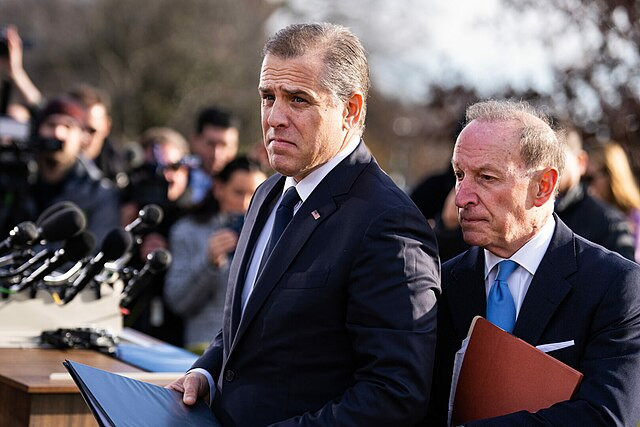
Hunter Biden's newly launched $LAPTOP meme coin soared to an implied valuation of more than $144 billion within minutes of beginning trading Wednesday before losing more than 95% of its value, an extraordinary swing driven in part by a market that initially contained only tens of thousands of dollars in liquidity.
The token, launched on Coinbase's Base blockchain with a supply of one billion coins, reached about $190 a token within roughly two minutes, according to blockchain analytics data cited by Decrypt and Quartz. Arkham put its fully diluted valuation at approximately $145 billion at one point even as liquidity stood at only about $48,000.
That valuation didn't mean investors had committed anything approaching $145 billion. Fully diluted valuation, or FDV, multiplies the latest token price by the entire supply, meaning a small number of transactions in a shallow decentralized-exchange pool can temporarily generate a headline valuation far beyond the amount buyers could actually realize by selling.
The distortion quickly unwound. The Wall Street Journal reported that $LAPTOP fell more than 95% from a peak of $199.51 to around $1.70, while other market snapshots captured prices around $3 to $5 during the collapse. The rapid reversal illustrated the extreme slippage possible when substantial orders encounter limited liquidity.
Trading nevertheless accelerated rapidly. Quartz reported approximately $19 million of volume across 314 trading pairs during the first hour, with an Aerodrome Slipstream USDC pool accounting for about 46.8% of turnover and Uniswap v4 capturing much of the remainder. Liquidity later increased to roughly $2.5 million, still a fraction of the token's quoted valuation.
The volatility followed a launch structured around Biden's personal history and his criticism of President Donald Trump's own $TRUMP meme coin. Before Wednesday's debut, Biden described $LAPTOP as an attempt to reclaim the story surrounding the laptop that became a major political controversy during his father Joe Biden's presidency, while criticizing $TRUMP as a "grift."
The project allocated 20% of its one billion tokens to two community airdrops. According to its published tokenomics, 10% of the supply was available through the Day-One distribution, including 2% earmarked for holders who suffered losses on $TRUMP and 8% for qualifying subscribers to Biden's "Where's Hunter?" newsletter.
Those tokens were immediately relevant to the trading dynamics because the Day-One allocation wasn't subject to the restrictions covering some of the project's other large holdings. The project's official disclosures say 35%, or 350 million tokens, were unlocked at the token-generation event, including the Day-One airdrop, liquidity allocation and foundation treasury.
Founders, including Biden, were allocated 30% of the supply, but those tokens are subject to a six-month lock followed by a 24-month vesting schedule. Another 30% is tied to a series of real-world predictions under an unusual mechanism that can result in tokens being burned or ultimately directed to charity.
Biden had explicitly cautioned prospective participants against treating his involvement as a promise of financial returns. "You should not expect me or anyone else to make this token more valuable for you," he wrote before the launch, according to The Block. "LAPTOP isn't just about owning something, it's about saying something."
The launch also attracted aggressive speculative buying. The Wall Street Journal said the token initially launched at $0.05, implying a $50 million valuation, before automated trading and buying on decentralized exchanges helped propel it as high as $199.51. Analysts cited by the Journal said the initial move was distorted by the decentralized-only debut and activity from automated "sniper" bots seeking to acquire tokens immediately after launch.
That market structure meant the spectacular valuation figures generated during the first minutes weren't equivalent to executable value. A token trading near $190 with one billion units outstanding could mathematically produce an FDV approaching $200 billion, but selling even a tiny fraction of that supply into a pool containing tens of thousands of dollars would push the price sharply lower.
Before $LAPTOP began trading, The Wall Street Journal noted that such tokens frequently surge after launch and then lose much of their value within hours or days, while Business Insider quoted Coin Bureau founder Nic Puckrin saying, "Even if there's a lot of demand at launch, that doesn't make it a sustainable investment."
The project's own website describes $LAPTOP as a meme coin created for entertainment and community participation rather than an asset conveying equity or ownership. It also warns that digital assets are volatile and can fall to zero-a disclosure that became particularly relevant within the first hour of trading as the token's enormous paper valuation collided with the limited liquidity available to support it.