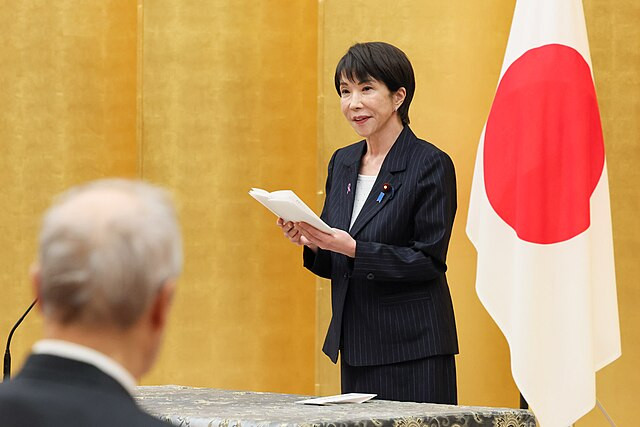
Japan moved this week to temper rising friction with China over the Taiwan Strait, as Prime Minister Sanae Takaichi publicly reaffirmed that Tokyo's position on Taiwan remains rooted in the 1972 Japan-China Joint Communique. The statement, delivered in parliament after weeks of heightened scrutiny from Beijing and domestic lawmakers, was framed as an attempt to reduce tensions sparked by her earlier suggestion that a Chinese attack on Taiwan could create a "survival-threatening situation" for Japan.
Takaichi told lawmakers, "The Japanese government's basic position regarding Taiwan remains as stated in the 1972 Japan-China Joint Communique, and there has been no change to this position." The communique states that "Taiwan is an inalienable part of the territory of the People's Republic of China," and that Japan "fully understands and respects this stand." Her reference to the document signaled an attempt to reassure Beijing while addressing questions raised by members of the Japanese parliament over whether her prior comments suggested a shift in national security doctrine.
Shinji Takeuchi of the Komeito Party warned that Takaichi's November remarks had affected Japan's tourism industry and risked escalating tensions unnecessarily. He pressed the prime minister to clarify whether Tokyo's policy remained unchanged under the terms of the joint agreement. Takaichi reiterated the government's long-standing position but did not retract her earlier statements on a Taiwan contingency.
Chinese analysts said the latest remarks appeared intended to deflect pressure without reversing course. Lian Degui of Shanghai International Studies University described Takaichi's clarification as "a play of words," arguing that Beijing remains concerned about the implications of her original language. The criticism reflects a larger debate within China about Japan's evolving security posture and what Beijing perceives as moves toward expanded military engagement.
Beijing escalated its response through high-level diplomatic channels. Chinese Foreign Minister Wang Yi, during a meeting with Russian Foreign Minister Sergei Lavrov, said, "As permanent members of the UN Security Council and comprehensive strategic partners of coordination for a new era, China and Russia should continue to coordinate and cooperate to resolutely curb the provocative acts of Japan's far-right forces that undermine regional peace and stability and attempt to remilitarize."
At a regular press briefing, Chinese Foreign Ministry spokesperson Lin Jian said Takaichi's earlier comments "openly challenge the victorious outcomes of World War II and the post-war international order, and constitute a serious violation of the purposes and principles of the Charter of the United Nations." Lin further criticized Japan for submitting a letter to the UN referencing what Tokyo called a consistent Taiwan position, stating, "As to what exactly this 'consistent position' is, the Japanese side has continued to evade the question and has yet to give China a direct answer. We ask the Japanese side once again: Can the Japanese government provide the international community with a complete and accurate explanation of its 'consistent position' on the Taiwan question as laid down in the four political documents between the two countries?"