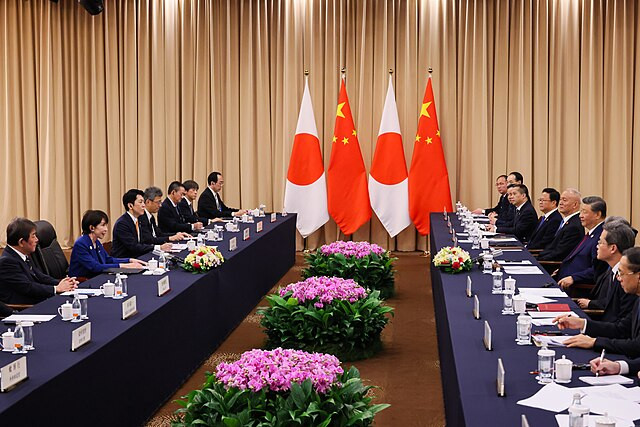
Tensions between China and Japan have intensified after Beijing rejected Japanese Prime Minister Sanae Takaichi's latest clarification regarding her earlier comments on Taiwan, insisting that Tokyo must fully retract what it calls "erroneous remarks." The exchange has added strain to a relationship already challenged by regional security concerns and the competing strategic interests of two major Asian powers. Beijing's Foreign Ministry spokesman Lin Jian said Thursday that China "absolutely does not accept" Tokyo's explanation, marking the latest escalation in a weeks-long dispute.
Takaichi, who became Japan's first female prime minister in October, told lawmakers this week that her government's "fundamental position regarding Taiwan remains unchanged from that stated in the 1972 Japan-China Joint Communique." She did not, however, explicitly restate the contents of that communique nor withdraw her November 7 statement that a Chinese military attack on Taiwan could constitute a "survival-threatening situation" for Japan-language that could legally permit mobilization of Japan's Self-Defense Forces.
Her original comments made Takaichi the first Japanese leader since World War II to publicly connect a Taiwan conflict with potential Japanese military engagement. Beijing swiftly condemned the statement as destabilizing and demanded a full retraction. On Thursday, after Takaichi appeared to soften her tone without retracting her earlier words, Beijing reiterated its demands. Lin Jian said, "Prime Minister Takaichi is still prevaricating by claiming that the Japanese side's position remains unchanged. China absolutely does not accept this."
Lin urged Japan to reverse course and invoked the 1972 document that normalized diplomatic relations between the two nations. That communique states that "the government of the People's Republic of China reiterates that Taiwan is an inalienable part of the territory of the People's Republic of China" and that the Japanese government "fully understands and respects this stand ... and it firmly maintains its stand under Article 8 of the Potsdam Proclamation." Lin pressed further, asking, "Why does the Japanese side just refuse to clearly articulate the commitments it has made and its legal obligations. What is the logic and agenda behind this?"
The historical statements referenced by Beijing remain central to the dispute. Article 8 of the Potsdam Declaration affirms that "the terms of the Cairo Declaration shall be carried out," and that Japan's post-war sovereignty would be limited to its main islands. The Cairo Declaration of 1943 further declared that territories taken from China-including Manchuria, Formosa (Taiwan), and the Pescadores-would be restored.
Beijing's firm stance follows decades of sensitivity around foreign statements related to Taiwan. For China, sovereignty over the island is a non-negotiable red line. For Japan, the issue blends legal obligations with national security calculations. Tokyo has grown more concerned about stability in the Taiwan Strait, especially given Japan's geographic proximity and its reliance on maritime trade routes that pass through contested waters.
In a parallel account of the diplomatic clash, Chinese officials repeated their view that Takaichi's comments were not misstatements but indicators of a potential shift in Japanese policy. Lin said Beijing urged Japan "to earnestly reflect on and correct its wrongdoing and retract Prime Minister Takaichi's erroneous remarks," accusing her of trying to "brush things off" by saying nothing had changed.