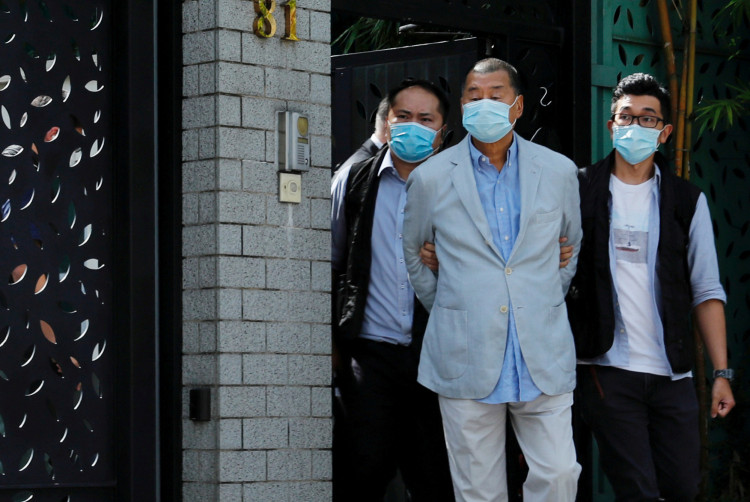
The conviction of Hong Kong media tycoon Jimmy Lai under the city's sweeping national security law has intensified global attention not only on his political fate but also on the future of a fortune once estimated at $1.2 billion. The ruling by Hong Kong's High Court on Monday leaves Lai, 78, facing the possibility of life imprisonment and raises the likelihood that assets frozen since his arrest could now be permanently confiscated.
Judges found the founder of the now-defunct pro-democracy newspaper Apple Daily guilty on two national security charges, including collusion with foreign forces, as well as a lesser sedition offense. In their written judgment, the court concluded Lai was the "mastermind of the conspiracies" alleged by prosecutors and ruled that his "only intent was to seek the downfall of the Chinese Communist Party." Sentencing has not yet been scheduled.
The nearly two-year trial has been widely viewed as a bellwether for Hong Kong's judicial independence following Beijing's imposition of the National Security Law in 2020. Under the statute, collusion with foreign forces carries a maximum penalty of life imprisonment.
Before his arrest, Lai was among Hong Kong's most prominent businessmen. After arriving from mainland China at age 12, he built a retail empire with the Giordano clothing chain before turning to media. He founded Apple Daily in 1995, transforming it into one of the city's most widely read tabloids and a vocal critic of Beijing's rule.
That media influence made Lai a central figure in Hong Kong's political confrontations in the years leading up to the 2019 mass protests. At his peak, his net worth was estimated at roughly £950 million ($1.2 billion), according to public estimates cited by CNN.
Much of that wealth has since been immobilized. Authorities froze Lai's assets shortly after his 2020 arrest, including shares in his company Next Digital and related bank accounts, using national security powers. The financial pressure intensified in 2021 when Apple Daily was forced to shut down following police raids and the arrest of senior executives, erasing the commercial value of his flagship business.
Court filings disclosed during the proceedings showed that Lai had limited access even to funds for legal expenses, underscoring how tightly his finances had been constrained well before the verdict.
The conviction now raises the prospect of forfeiture. Legal specialists note that asset freezes imposed during investigations can escalate into permanent confiscation after conviction, particularly in national security cases. While the court has not yet ruled on seizure, the likelihood has increased substantially.
The case has drawn international condemnation. Judges cited Lai's contacts with U.S. officials, including meetings with then Vice President Mike Pence and then Secretary of State Mike Pompeo, as well as a New York Times opinion article published in May 2020, as evidence of collusion. In the ruling, the panel compared his actions to "an American national asking Russia to bring down the US government."